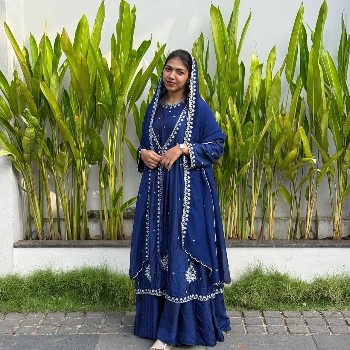
All three sit under "ethnic wear" on every shopping site, which is exactly why people end up buying the wrong one. Here is what separates them and which one actually fits the day you're dressing for.
Cut, formality, and practical fit at a glance
Factor Salwar suit Anarkali suit Kurta set
Silhouette Fitted top, loose trousers Flared, frock-like top Straight or A-line top
Pieces Top, bottom, dupatta Top, churidar or leggings, dupatta Top and bottom, usually no dupatta
Formality Medium — everyday to small functions High — weddings and festive events Low — daily wear and office
Ease of movement High Lower — fabric volume restricts quick movement Highest
Typical fabric weight Light to medium Medium to heavy, often layered Light, breathable
Which one for which occasion
The formality of the event should decide the silhouette, not the other way round. A heavily embroidered anarkali at a casual lunch reads as overdressed. A plain kurta set at a wedding reception reads as underdressed. Matching the two correctly is the entire skill.
Wedding / reception
Anarkali suit
The flare photographs well and carries heavier embroidery without looking stiff. Best for evening functions and the reception itself.
Mehendi / daytime function
Salwar suit
Festive enough without the bulk of an anarkali. Easier to sit and move in through a long daytime event.
Office / daily wear
Kurta set
No dupatta to manage, fewer pieces to iron, and a cut that moves with you through a full working day.
What MULAWWAN has in each category
Each of the three formats above is available at MULAWWAN in Moonalingal, near Lakeshore Hospital, Kozhikode. The pieces below are current stock, not a general description of what the store "offers" — these are the actual products.
Available now:
Embroidered Blue Anarkali Suit
₹15,999
Embroidered Lemon Yellow Salwar Suit
₹9,500
Embroidered Kurta Set
₹8,500
A simple way to decide before you buy
Check the invitation card or the event description first. "Reception" or "wedding function" points to an anarkali. "Mehendi," "haldi," or "small function at home" points to a salwar suit. Anything without an occasion attached — work, college, visiting family — points to a kurta set.
If the event sits between two categories, go one notch less formal rather than more. An overdressed guest stands out more than an underdressed one, and a salwar suit can be styled up with jewellery in a way that an anarkali cannot easily be styled down.
Common questions
What is the difference between a salwar suit and an anarkali suit?
A salwar suit has a fitted or semi-fitted top paired with loose trousers narrowed at the ankle. An anarkali suit has a long, flared top that falls like a frock to the knee or floor, usually worn over leggings or churidar. The anarkali silhouette is fuller and more formal; the salwar suit is straighter and more wearable for everyday use.
Is a kurta set the same as a salwar suit?
No. A kurta set pairs a straight or A-line kurta with matching or contrasting bottoms, often without a dupatta, and is cut for daily comfort. A salwar suit traditionally includes three pieces — top, bottom, and dupatta — and reads as slightly more occasion-specific than a kurta set.
Which is better for a wedding, anarkali or salwar suit?
For a wedding function, an anarkali suit is the stronger choice because the flared silhouette and heavier embroidery photograph better and read as more festive. A salwar suit works for smaller wedding events such as a mehendi or a daytime function where a heavier anarkali would feel like too much.
Can a kurta set be worn to office?
Yes. A straight-cut kurta set in cotton or a cotton blend, without heavy embroidery, is one of the most common choices for office wear in Kerala. It moves easily, does not need ironing as often as a salwar suit, and does not draw the attention an anarkali would in a workplace.
Where can I buy salwar suits and anarkali suits in Kozhikode?
MULAWWAN, a family clothing store in Moonalingal near Lakeshore Hospital, Kozhikode, stocks embroidered salwar suits, anarkali suits, and kurta sets. Contact via WhatsApp at +91 90613 94129.
Shop at MULAWWAN, Moonalingal
62 1054 A, Moonalingal, near Lakeshore Hospital, Kozhikode. Address Verified, Business Verified. Salwar suits, anarkali suits, and kurta sets in stock.
WhatsApp: +91 90613 94129
Shop now View store
MULAWWAN, Moonalingal, Kozhikode · June 2026 · 5 min read
A salwar suit, an anarkali suit, and a kurta set are not interchangeable, even though most online stores file them under the same category. The difference is in the cut, and the cut decides where each one belongs — a wedding hall, a Monday at the office, or a Sunday at home.
The mix-up usually happens at the point of buying. Someone needs something for a cousin's wedding, searches "ethnic wear Kozhikode," and ends up choosing based on the photo rather than the silhouette. The photo doesn't tell you how the garment moves or how formal it reads in person. The cut does.
A salwar suit is a fitted top with loose trousers, built for everyday wear and smaller functions. An anarkali suit has a flared, frock-like top that falls to the knee or floor, built for weddings and formal events. A kurta set is a straight-cut top with simple bottoms and no dupatta, built for daily comfort and office wear. Match the occasion's formality to the garment's silhouette, not the other way round.
The actual difference between the three
The salwar suit is the oldest of the three formats. The top sits close to the body through the chest and loosens below the waist, paired with trousers that narrow at the ankle. A dupatta usually completes the set. The shape is straight up and down, which is what makes it practical — it doesn't billow, it doesn't need careful seating arrangements, and it works under a cardigan in cooler weather.
The anarkali suit changes the silhouette completely. The top is cut with panels that flare out from the waist, so the finished garment falls like an A-line frock rather than a fitted top. The flare is what reads as festive in photographs — it moves when you walk, and embroidery placed on the panels catches more light than the same embroidery on a flat salwar top. That same flare is also why an anarkali takes up more space and is harder to manage in a crowded function or a car back seat.
The kurta set strips away both the dupatta and the structured tailoring. It's a straight or slightly A-line top paired with leggings, palazzos, or straight pants, sold as a matching set. There's no formal three-piece structure to think about. That's exactly why it works for office wear and daily errands — fewer pieces, faster to put on, easier to wash and iron.


 Select Date
 08:00 AM - 08:30 AM, Thursday, Nov 24, 2024
 Indian Standard Time
 Shahanab
Comments (0)