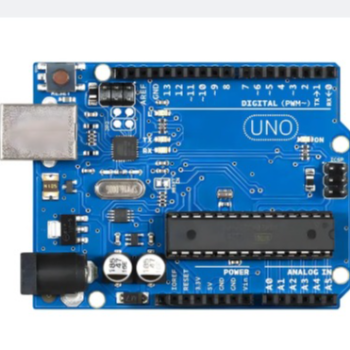
Arduino Uno R3 ATmega328P USB Development Board

Overview The UNO R3 Development Board is a cost-effective microcontroller board based on the ATmega328P. It features the ATMega16U2 as a USB driver, which provides reliable USB-to-serial communication, for programming and debugging. Fully compatible with the Arduino IDE, this board supports easy code uploads and extensive community-driven resources. With an operating voltage of 5V, the UNO R3 can be powered through USB or an external power supply (7-12V recommended, 6-20V max), offering flexibility for various applications. It comes with 14 digital I/O pins, of which 6 support PWM, along with 6 analog input pins, allowing for a wide range of sensor and actuator connections. The board has 32 KB of flash memory, including 0.5 KB reserved for the bootloader, 2 KB of SRAM, and 1 KB of EEPROM for data storage. The 16 MHz clock speed ensures efficient processing speeds, making the board ideal for real-time applications. Communication is supported through UART, SPI, and I2C interfaces, providing connectivity options for external modules. It features a USB Type-B connector for programming and power, along with built-in LED indicators for power and status monitoring. Compact and lightweight at approximately 25g, the UNO R3 is perfect for prototyping and embedded development. Applications The UNO R3 is widely used in DIY electronics, robotics, IoT prototyping, home automation, sensor-based projects, data logging, and educational learning projects.


₹ 435 0% off
₹ 0

The Arduino Uno R3 is a versatile microcontroller board based on the ATmega328P, ideal for beginners, students and hobbyists building electronics, robotics and IoT projects. It offers 14 digital I/O pins, 6 analog inputs and multiple communication interfaces including UART, SPI and I2C for connecting sensors and modules. With a 16 MHz clock, 32 KB flash memory and onboard USB interface, it ensures smooth code uploads and stable performance. The board can be powered via USB or external supply, making it flexible for both desktop and embedded use. Available from VELLORE ROBO ELECTRONICS no 7 Surya complex opp to VIT main gate katpadi vellore 632014, it’s perfect for prototyping and education.

ATmega328P-based board for reliable, stable performance
Fully compatible with Arduino IDE for easy coding
14 digital I/O pins for flexible device control
6 analog inputs ideal for sensor interfacing
USB Type-B interface for simple programming and power
Supports UART, SPI and I2C communication protocols

Connect the Arduino Uno R3 to your computer using a USB Type-B cable. Install and open the Arduino IDE, then select the correct board and port from the Tools menu. Write or load your sketch, verify it, and click Upload. Connect sensors, modules or actuators to the I/O pins as required.

The Arduino Uno R3 is used for building and prototyping electronic projects such as DIY electronics, robotics, IoT devices, home automation and sensor-based systems. Its easy-to-use hardware and Arduino IDE support make it ideal for students, hobbyists and engineers to quickly test ideas and create working prototypes.

Yes, the Arduino Uno R3 is one of the best boards for beginners. It has a simple layout, USB programming, plenty of tutorials and a large community. Using the Arduino IDE, new users can learn coding, basic electronics and interfacing sensors or motors without needing complex hardware or tools.

The Uno R3 is an updated version of the original Arduino Uno, featuring improved USB communication with an ATmega16U2 chip and more robust reset circuitry. Functionally they are similar, but the Uno R3 offers better compatibility, stability and support with newer Arduino IDE versions and shields.

Yes, the Arduino Uno R3 is widely used for IoT prototyping. By adding Wi-Fi, Ethernet or GSM modules via UART, SPI or I2C, you can connect sensors to the internet, log data and control devices remotely. It’s ideal for learning IoT concepts and building small connected systems.

The Arduino Uno R3 operates at 5V and can be powered through USB or an external supply. The recommended external input is 7–12V via the DC jack or Vin pin, with an absolute range of 6–20V. This ensures stable regulation while safely powering connected sensors and modules.