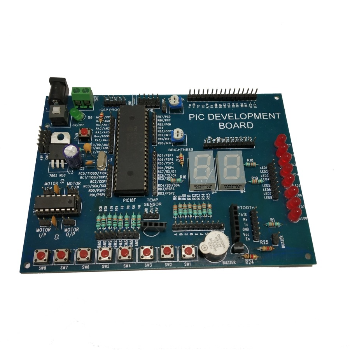
PIC Microcontroller Board for Beginners Learning & Projects

On board Two Line LCD Display (2x16) , Two multiplexed 7-Segment LED Display, Built in Switches (8 keys), Built in 8 LED Interface to test I/O, On Board External Interrupt and Reset buttons, Built in Potentiometer interface to ADC, Temperature Sensor Interface (LM35) & Bluetooth Interface (HC-05) Connector, Buzzer*Specially Design by R&D experts for beginner, learner, project lover, engineer, hobbyist for implementing your imagination code in real world of digital electronics, embedded system & robotics*All Port & 35 Pins are Breakout Pins are available at male bugs Connector which can be used as main board for developing applications*Compact and Ready to use design & Professional High Quality Glass PCB Layout Design for Noise Reduction with Board Supports Microchip's PIC16F877A, PIC16F887A, PIC18Fxx Microcontrollers


₹ 2800 0% off
₹ 0

This PIC microcontroller board is a complete development platform designed for beginners, engineering students, hobbyists and project enthusiasts. It supports popular Microchip PIC16F877A, PIC16F887A and PIC18Fxx microcontrollers, making it ideal for learning, prototyping and academic projects. On-board peripherals such as 2x16 LCD, multiplexed 7-segment displays, keys, LEDs, buzzer, LM35 sensor interface and Bluetooth connector simplify testing and coding tasks. All ports and 35 pins are broken out on robust male connectors for easy interfacing with external modules and shields. The professional glass PCB layout reduces electrical noise and ensures reliable, long-term performance. Available from VELLORE ROBO ELECTRONICS no 7 Surya complex opp to VIT main gate katpadi vellore 632014 for your embedded lab or workspace.

On-board LCD and 7-segment displays for easy output testing
Eight keys and eight LEDs to verify I/O operations
LM35 temperature and Bluetooth HC-05 ready interfaces
All ports and 35 pins available on breakout headers
Supports PIC16F877A, PIC16F887A, PIC18Fxx families
Low-noise professional glass PCB for stable operation

Insert a compatible PIC microcontroller into the socket and ensure correct orientation. Connect power supply as specified in the board manual. Use an external PIC programmer to burn your hex file. Connect LCD, sensors or modules to the breakout pins as needed. Test I/O using on-board keys, LEDs, buzzer and displays. Interface LM35 and Bluetooth HC-05 through provided connectors for sensor and wireless experiments. Always power off the board before changing connections or microcontrollers.

A PIC microcontroller board is used to learn, prototype and test embedded systems and electronics projects. You can write code, program the PIC, and immediately verify inputs and outputs using on-board LEDs, switches, displays and sensors. It is ideal for academic projects, robotics, automation and quick proof-of-concept designs.

Yes, this pic microcontroller board is specially designed for beginners and learners. It includes built-in LCD, 7-segment displays, keys, LEDs and sensor interfaces, so you don’t need complex wiring. Clear breakout pins make understanding ports easier, helping students, hobbyists and first-time users quickly see how their code controls real hardware.

This development board supports popular Microchip PIC16F877A, PIC16F887A and PIC18Fxx series microcontrollers. These MCUs are widely used in colleges and training institutes, so you can reuse your existing code and tutorials. The socket and pinout are arranged to make swapping between supported PIC devices simple and convenient for different projects.

Yes, the board provides an interface for the LM35 temperature sensor, a potentiometer connected to the ADC for analog experiments, and a dedicated connector for the HC-05 Bluetooth module. These ready-made interfaces let you quickly build wireless and sensor-based applications without complex breadboard wiring or additional interface circuits.

You can confidently use this PIC microcontroller board for engineering, diploma and school projects. It offers professional-quality PCB design, breakout pins for all ports, and support for standard PIC controllers commonly required in syllabi. Students can build robotics, automation, IoT prototypes and mini-projects faster, with reliable hardware for lab evaluations.